The Four-Season Maintenance Timeline
Grass growth does not follow a straight line. In spring and early summer, perennial ryegrass produces leaf tissue rapidly, tillering outward and requiring constant mowing. In January, leaf cell division slows almost to a halt while roots endure sub-zero freezes and soaking squalls. A successful grounds manager anticipates these physiological transitions before they occur.
Spring: Kickstarting Root Renewal
As soil temperatures creep past 8°C in March and April, the turf wakes up hungry. The focus shifts to dragging away winter dead material, restoring air movement into compacted goal areas, and applying balanced slow-release spring fertilizers with a balanced nitrogen-to-potassium ratio. Mowing heights are gently lowered from winter heights of 30mm down toward playing heights of 25mm in careful half-millimetre increments.
Summer: Renovation & Sward Establishment
The precious six-to-eight-week closed season is the primary opportunity for heavy corrective surgery:
- Aggressive Fraise Mowing or Scarification: Stripping out annual meadow grass (Poa annua), dead thatch and accumulated silt from the top 10mm.
- Laser Top-Dressing: Spreading 60 to 100 tonnes of washed medium-to-coarse silica sand per pitch to correct minor depressions and maintain surface levels.
- Dimple/Disc Overseeding: Sowing 100% tetraploid and diploid perennial ryegrass blends at rates suited to the budget and fixture demand.
- Germination Hydration: Running gentle irrigation cycles multiple times a day to ensure tender shoots never dry out in the summer heat.
Autumn: Hardening the Leaf and Resisting Disease
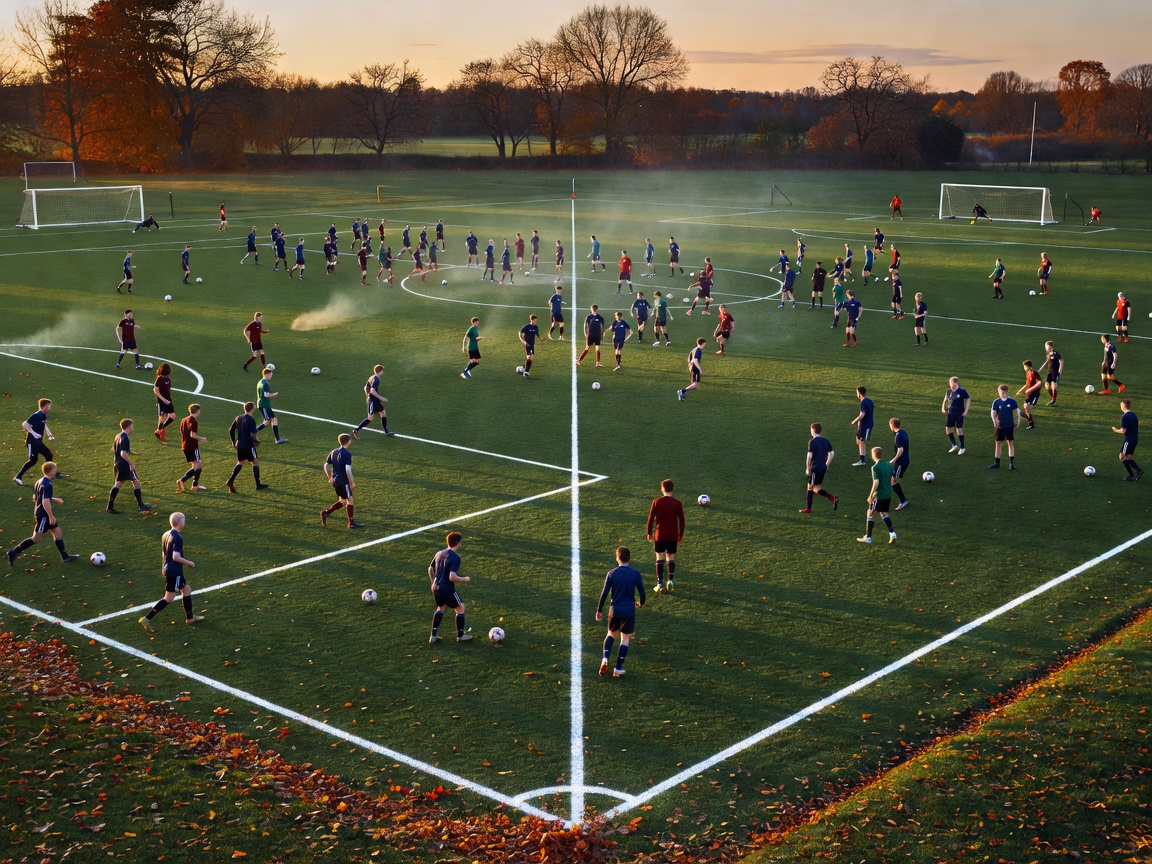
By September, fixtures are underway every weekend. As sunlight hours dwindle and morning dew sits longer on the grass blade, disease pressures peak—especially Microdochium patch (Fusarium). High nitrogen is strictly avoided; instead, autumn applications emphasize potassium and iron to harden leaf cell walls, deepen green colour without flushes of soft growth, and encourage fungal resistance.
Winter: Preservation, Frost & Wear Survival
In deep winter, the ground care golden rule is simple: minimize mechanical traffic whenever the leaf is frozen or the ground is saturated. Walking or driving machinery across a frost-covered pitch snaps frozen grass cells, turning the turf black and killing the crowns. Cutting is reduced to occasional topping at 28–32mm, focusing instead on dew brushing, divoting, and keeping drainage outfalls clear.
Winter Frost & Dew Management Tip
Removing heavy morning dew using a drag brush or switch line significantly reduces the humidity envelope around the leaf blade, reducing the window for fungal spores to colonize the turf without chemical fungicides.
Balancing Mid-Season Fixture Congestion
Every amateur and professional league suffers postponements in December that cascade into a grueling Tuesday-Thursday-Saturday schedule by April. When matches arrive back-to-back, heavy grooming must cease. Operations reduce to the bare essentials: post-match divot stamping, light aeration with thin pencil tines, and protecting the six-yard box with breathable germination covers between fixtures.